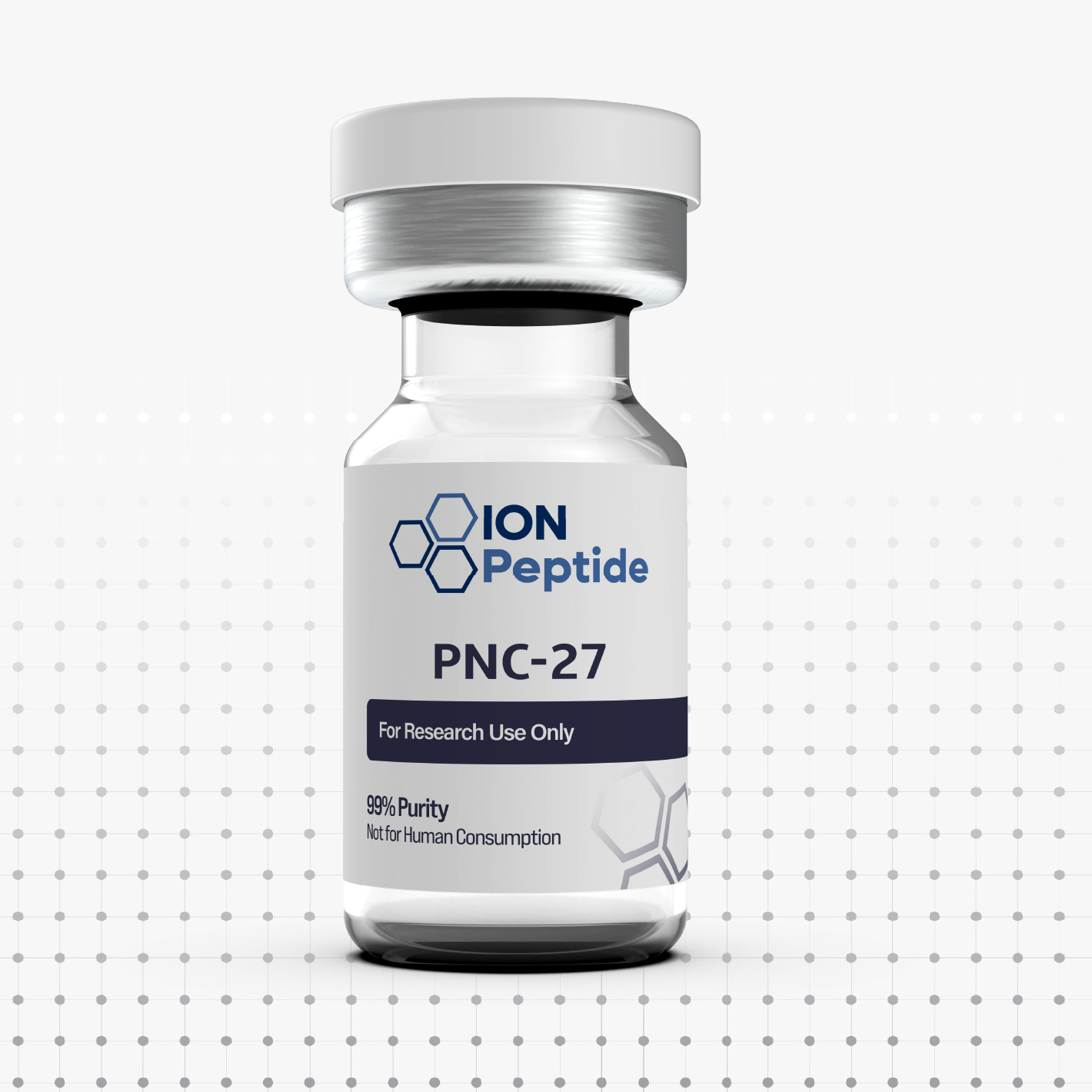
PNC-27 – 10mg

$119.00

For research purposes only. Not for human or animal use & not FDA-approved. By purchasing, you confirm you are 21 or older and qualified researcher.

Out of stock

Join the waitlist to be emailed when this product becomes available

Description

PNC-27

Research-Grade Synthetic Peptide
Tagline: Peptide–Membrane Interaction Research


Product Description

PNC-27 is a synthetic peptide construct composed of a sequence derived from the p53 protein domain linked to a membrane-interacting peptide segment. In laboratory research, PNC-27 is studied for its role in peptide–protein interactions, membrane association behavior, and cellular signaling models.

PNC-27 is used as a model peptide in controlled experimental systems investigating protein domain interactions, peptide-induced membrane effects, and structure–function relationships. Its activity is examined in in vitro and biochemical research settings, without implication of therapeutic application.

For Laboratory and Scientific Research Use Only. Not for Human Consumption.


Why Researchers Choose PNC-27
  • Synthetic peptide with defined sequence and structure
  • Derived from well-characterized protein domain (p53 region)
  • Suitable for membrane interaction and peptide-binding studies
  • Used in structure–function and signaling pathway research
  • Applicable in in vitro experimental systems
  • Documented in peer-reviewed peptide research literature

Important Note

For laboratory and scientific research only. Not for human consumption, diagnostic, or therapeutic use.
Details

<table style=”width:100%; border-collapse: collapse;”>
<tr>
<td><strong>Compound Name</strong></td>
<td>PNC-27</td>
</tr>
<tr>
<td><strong>Compound Class</strong></td>
<td>Synthetic peptide construct</td>
</tr>
<tr>
<td><strong>Peptide Type</strong></td>
<td>Protein-derived sequence (p53-linked peptide)</td>
</tr>
<tr>
<td><strong>Target Context (Research)</strong></td>
<td>Peptide–protein interaction, membrane interaction studies</td>
</tr>
<tr>
<td><strong>Form</strong></td>
<td>Lyophilized powder</td>
</tr>
<tr>
</table>

Research

Research Applications

Peptide–Protein Interaction Studies

PNC-27 is used in laboratory models examining interactions between peptide sequences and protein domains, particularly those derived from regulatory proteins.

Membrane Interaction & Permeability Research

This peptide construct is studied for its ability to associate with cell membranes, supporting research into membrane binding, permeability, and peptide-induced structural effects.

Structure–Function Relationship Analysis

PNC-27 is used in experimental systems evaluating how specific peptide sequences influence molecular behavior and binding characteristics.

In Vitro Cellular Model Research

Researchers utilize PNC-27 in controlled environments to investigate peptide-driven cellular interactions and signaling responses.


References
  1. PNC-27 peptide — research overview and mechanism studies.
    https://pubmed.ncbi.nlm.nih.gov/16702361/
  2. Peptide–membrane interactions and structure-function relationships.
    https://www.ncbi.nlm.nih.gov/pmc/articles/PMC3183920/
  3. p53 protein — structure and function overview.
    https://en.wikipedia.org/wiki/P53
  4. Peptide structure and classification overview.
    https://en.wikipedia.org/wiki/Peptide

Mechanism of Action

Mechanism of Action
Protein Domain Interaction (p53-Derived Segment)

PNC-27 contains a sequence derived from the p53 protein, enabling study of peptide–protein binding interactions in experimental systems.

Membrane Association Behavior

The peptide includes a membrane-interacting segment that allows it to associate with lipid bilayers, supporting membrane interaction research.

Peptide-Induced Structural Effects

In laboratory models, PNC-27 is studied for its potential to influence membrane structure and integrity under controlled conditions.

Sequence-Dependent Activity

The behavior of PNC-27 is dependent on its specific amino acid sequence, making it suitable for structure–activity relationship (SAR) studies.


References
  1. PNC-27 peptide — research overview and mechanism studies.
    https://pubmed.ncbi.nlm.nih.gov/16702361/
  2. Peptide–membrane interactions and structure-function relationships.
    https://www.ncbi.nlm.nih.gov/pmc/articles/PMC3183920/
  3. p53 protein — structure and function overview.
    https://en.wikipedia.org/wiki/P53
  4. Peptide structure and classification overview.
    https://en.wikipedia.org/wiki/Peptide