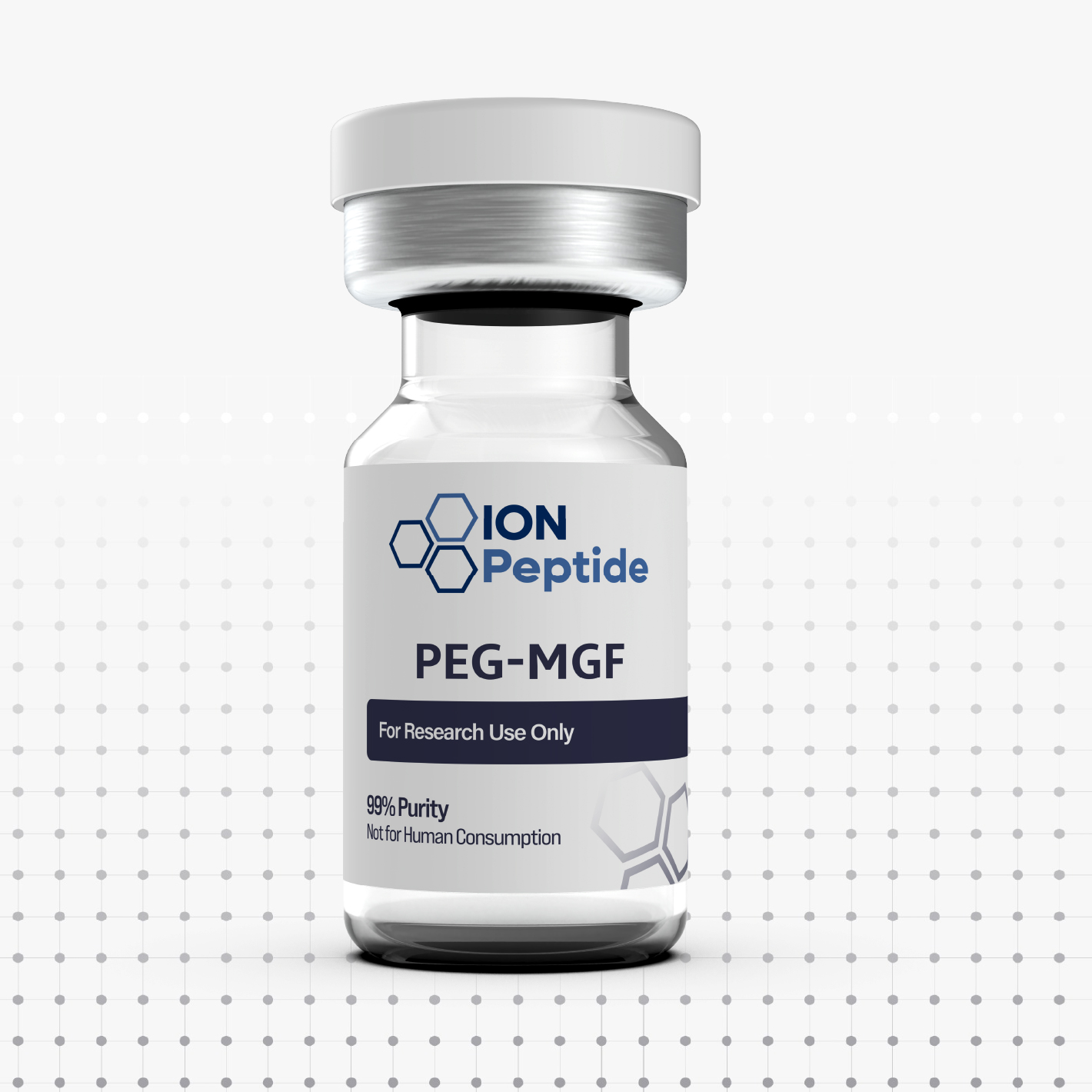
PEG-MGF – 2mg

$39.00

For research purposes only. Not for human or animal use & not FDA-approved. By purchasing, you confirm you are 21 or older and qualified researcher.

In stock

Quantity Price
4 - 5 $35.10
6 - 9 $32.76
10 + $29.25
Money Back Guarantee Guaranteed Quality Customer Support Fast Shipping
Categories: , ,

Description

PEG-MGF (Pegylated Mechano Growth Factor)

Research-Grade IGF-1 Isoform
Tagline: Muscle Repair & Regeneration Research


Product Description

PEG-MGF (Pegylated Mechano Growth Factor) is a pegylated form of MGF, an isoform of insulin-like growth factor-1 (IGF-1) expressed in response to mechanical stress and muscle damage. Pegylation extends the peptide’s half-life, allowing sustained activity in research applications.

Researchers use PEG-MGF in studies exploring muscle hypertrophy, satellite cell activation, tissue repair, and regenerative medicine. It is an important tool in investigating muscle adaptation to mechanical load and injury.

For Laboratory and Scientific Research Use Only. Not for Human Consumption.


Why Researchers Choose PEG-MGF
  • Extended Half-Life: Pegylation significantly prolongs in vivo stability compared to native MGF.

  • Muscle Growth Research: Stimulates satellite cell activation and myoblast proliferation.

  • Regenerative Medicine Relevance: Studied for potential roles in tissue repair and recovery.

  • Synergy with IGF-1: Complements systemic IGF-1 studies by focusing on localized muscle response.

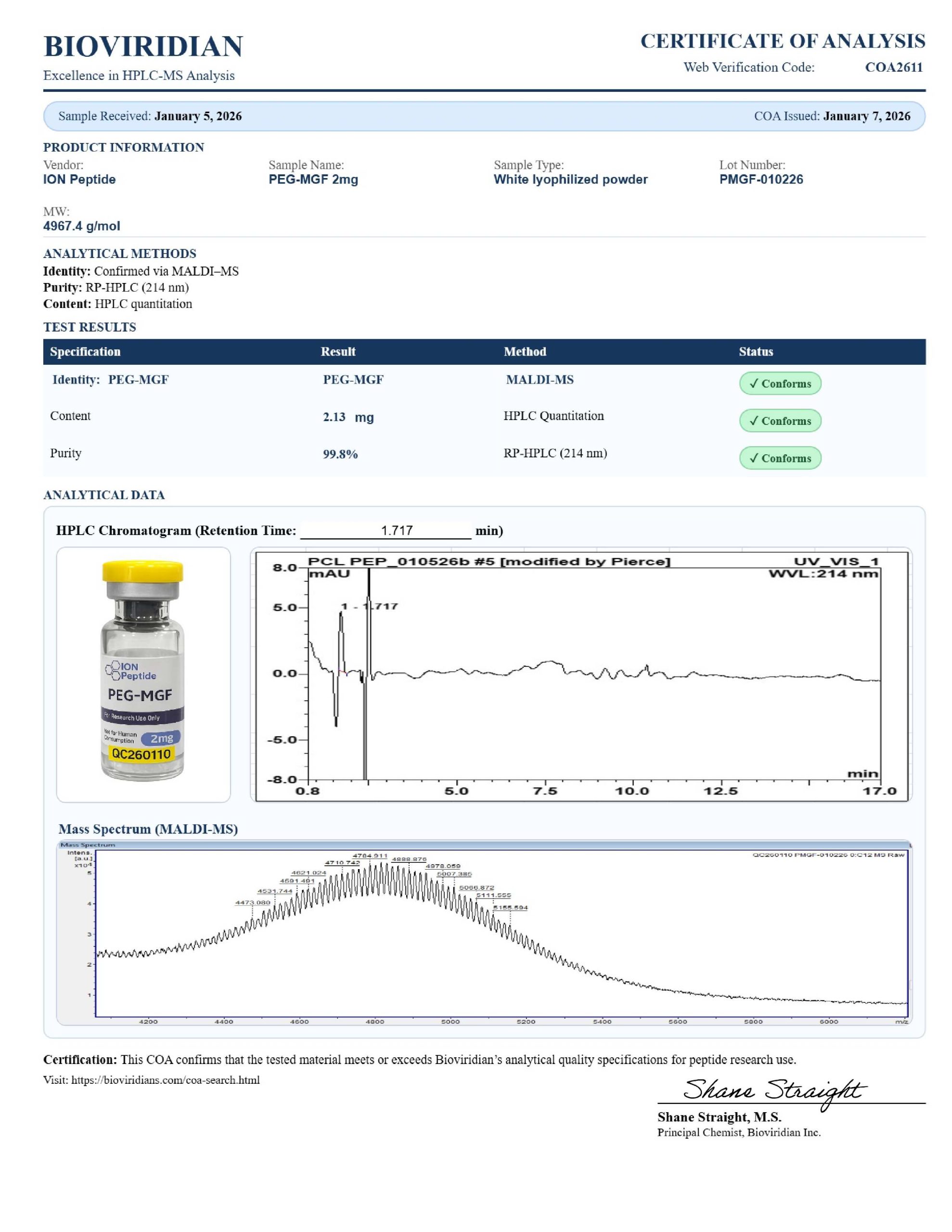
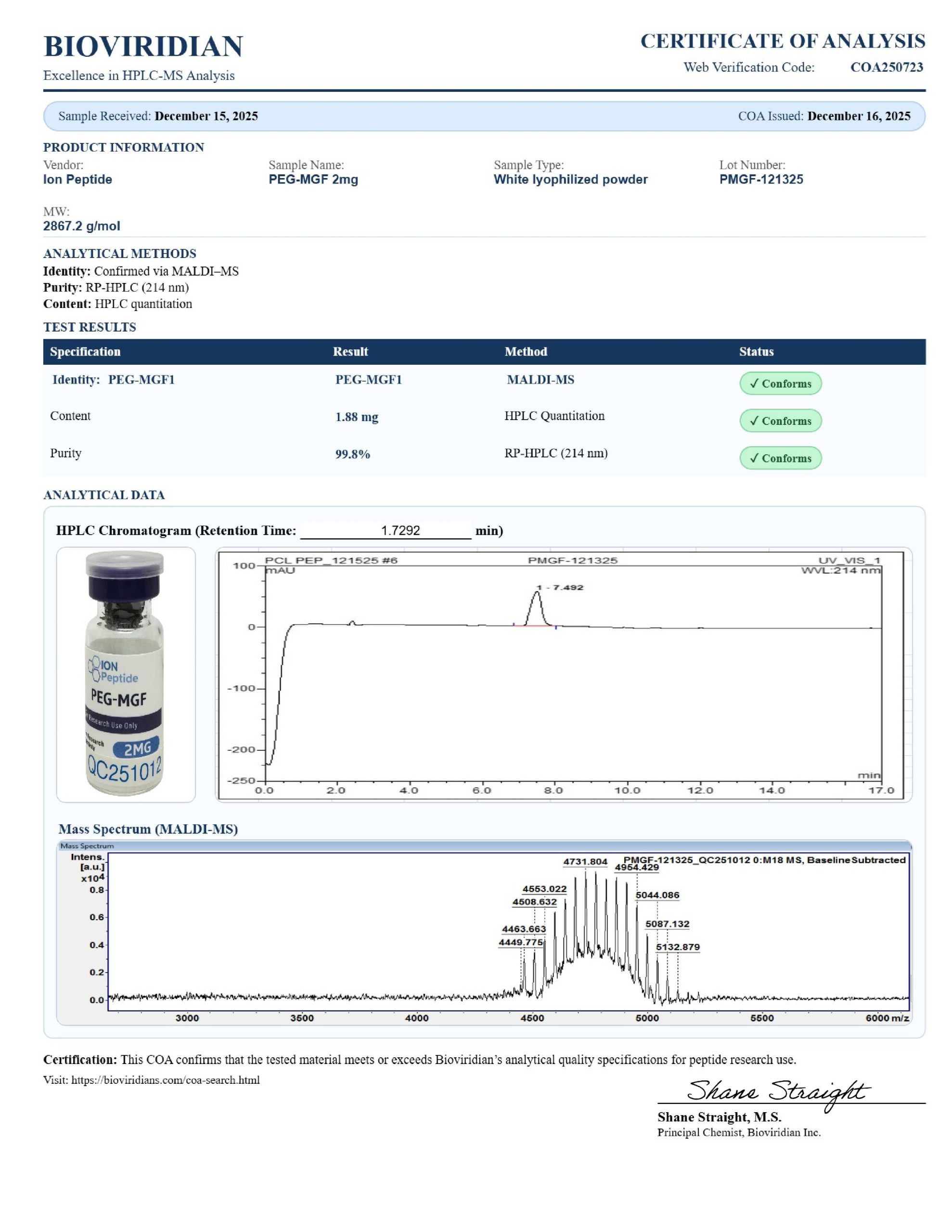
  • Batch Verified: ≥98% purity, HPLC and MS-tested for reproducibility.


Important Note

For laboratory and scientific research only. Not for human consumption, therapeutic, or diagnostic use.
Details

Chemical Formula Varies with pegylation; based on MGF (C₁₂₁H₂₀₀N₄₂O₃₉S)
Molecular Mass ~2888 Da (MGF core) + PEG chain (variable)
CAS Number Not assigned (synthetic pegylated peptide)
Form Lyophilized pegylated peptide powder
Shelf Life 24 months (lyophilized)
Intended Use For preclinical and in vitro research only
Storage -20 °C (dry powder), -80 °C (after reconstitution)

Research

Research Applications

Muscle Hypertrophy & Regeneration

PEG-MGF has been shown to activate muscle satellite cells and promote myoblast proliferation in response to mechanical overload [1].

Tissue Repair Studies

Used in models of muscle injury to investigate accelerated repair and reduced fibrosis [2].

Aging & Sarcopenia Research

Explored as a potential therapeutic model for age-related muscle loss and regenerative decline [3].

Combination Studies with IGF-1

Studied alongside systemic IGF-1 analogues to understand local vs systemic effects of growth factor signaling [4].


References
  1. Goldspink G (2005). Mechanical Signals, IGF-1 Isoforms, and Muscle Growth. J Appl Physiol.
    https://journals.physiology.org/doi/epdf/10.1152/physiol.00004.2005

  2. Hill M et al. (2003). MGF Expression and Muscle Repair Following Injury. J Physiol.
    https://www.physoc.org/magazine-articles/mgf-a-local-growth-factor-or-a-local-tissue-repair-factor/

  3. Owino V et al. (2001). IGF-1 Isoforms and Age-Related Muscle Loss. FASEB J.
    https://www.physoc.org/magazine-articles/mgf-a-local-growth-factor-or-a-local-tissue-repair-factor/

  4. McKay BR et al. (2008). Synergistic Effects of IGF-1 and MGF on Muscle Cells. Am J Physiol Cell Physiol.
    https://link.springer.com/chapter/10.1007/978-3-319-27511-6_2

Mechanism of Action

Mechanism of Action (How PEG-MGF Works)
  • Satellite Cell Activation: Binds IGF-1 receptors, stimulating quiescent satellite cells to enter the cell cycle [Goldspink 2005].

  • Myoblast Proliferation: Promotes differentiation and fusion of myoblasts into existing muscle fibers [Hill 2003].

  • Pegylation Advantage: Prolongs half-life, maintaining bioactivity for extended periods in vivo [Owino 2001].

  • Local Tissue Repair: Encourages ECM remodeling and reduces scar tissue formation [Hill 2003].

  • Synergistic Growth Response: Enhances anabolic signaling when combined with IGF-1 [McKay 2008].


References
  1. Goldspink G (2005). Mechanical Signals, IGF-1 Isoforms, and Muscle Growth. J Appl Physiol.
    https://journals.physiology.org/doi/epdf/10.1152/physiol.00004.2005

  2. Hill M et al. (2003). MGF Expression and Muscle Repair Following Injury. J Physiol.
    https://www.physoc.org/magazine-articles/mgf-a-local-growth-factor-or-a-local-tissue-repair-factor/

  3. Owino V et al. (2001). IGF-1 Isoforms and Age-Related Muscle Loss. FASEB J.
    https://www.physoc.org/magazine-articles/mgf-a-local-growth-factor-or-a-local-tissue-repair-factor/

  4. McKay BR et al. (2008). Synergistic Effects of IGF-1 and MGF on Muscle Cells. Am J Physiol Cell Physiol.
    https://link.springer.com/chapter/10.1007/978-3-319-27511-6_2

Certificate of Authenticity