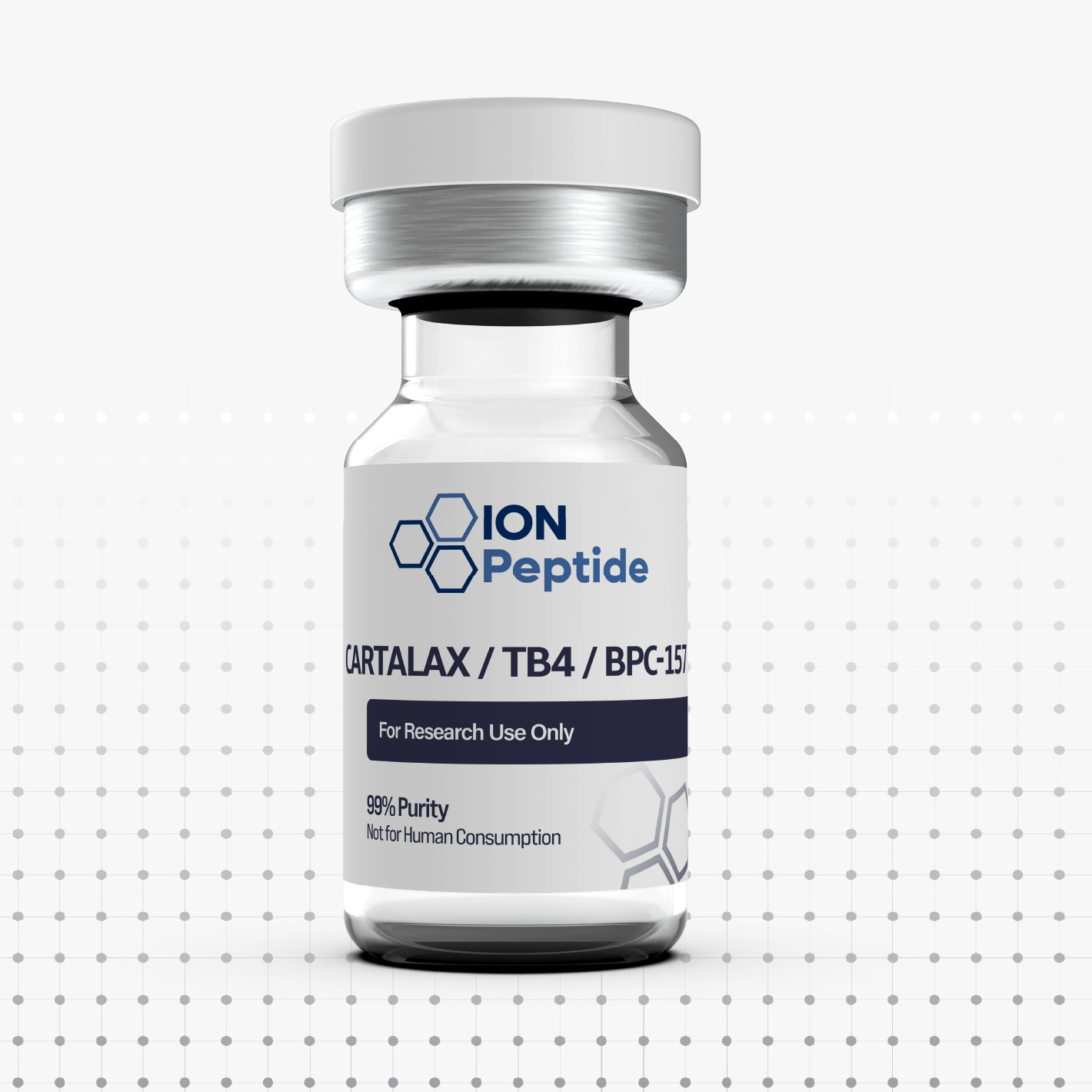
Cartalax / TB4 / BPC-157 – 40mg

$129.00

For research purposes only. Not for human or animal use & not FDA-approved. By purchasing, you confirm you are 21 or older and qualified researcher.

In stock

Quantity Price
4 - 5 $116.10
6 - 9 $108.36
10 + $96.75
Money Back Guarantee Guaranteed Quality Customer Support Fast Shipping

Description

Cartalax / TB4 / BPC-157

Research-Grade Multi-Peptide Formulation
Tagline: Combinational Peptide Signaling Research


Product Description

Cartalax / TB4 / BPC-157 is a research-grade multi-peptide formulation containing three distinct peptide components supplied as a single lyophilized preparation for laboratory investigation.

This formulation includes:

  • Cartalax – a short tissue-associated peptide bioregulator model

  • Thymosin Beta-4 (TB4) – a 43–amino acid endogenous peptide studied for cytoskeletal interactions

  • BPC-157 – a synthetic pentadecapeptide investigated in peptide signaling models

The combined formulation is designed for controlled experimental research exploring peptide interaction dynamics, structural behavior, intracellular signaling mechanisms, and multi-component peptide systems.

This product is supplied as a single blended research complex, not as separate individual compounds.

For Laboratory and Scientific Research Use Only. Not for Human Consumption.


Why Researchers Choose This Formulation
  • Multi-peptide research blend in a single vial

  • Combines tissue-associated, cytoskeletal, and signaling peptide classes

  • Suitable for combinational pathway research

  • Lyophilized for stability and controlled reconstitution

  • Documented peptide classes in peer-reviewed literature

  • Designed for controlled laboratory investigation


Important Note

For laboratory and scientific research only. Not for human consumption, diagnostic, or therapeutic use.
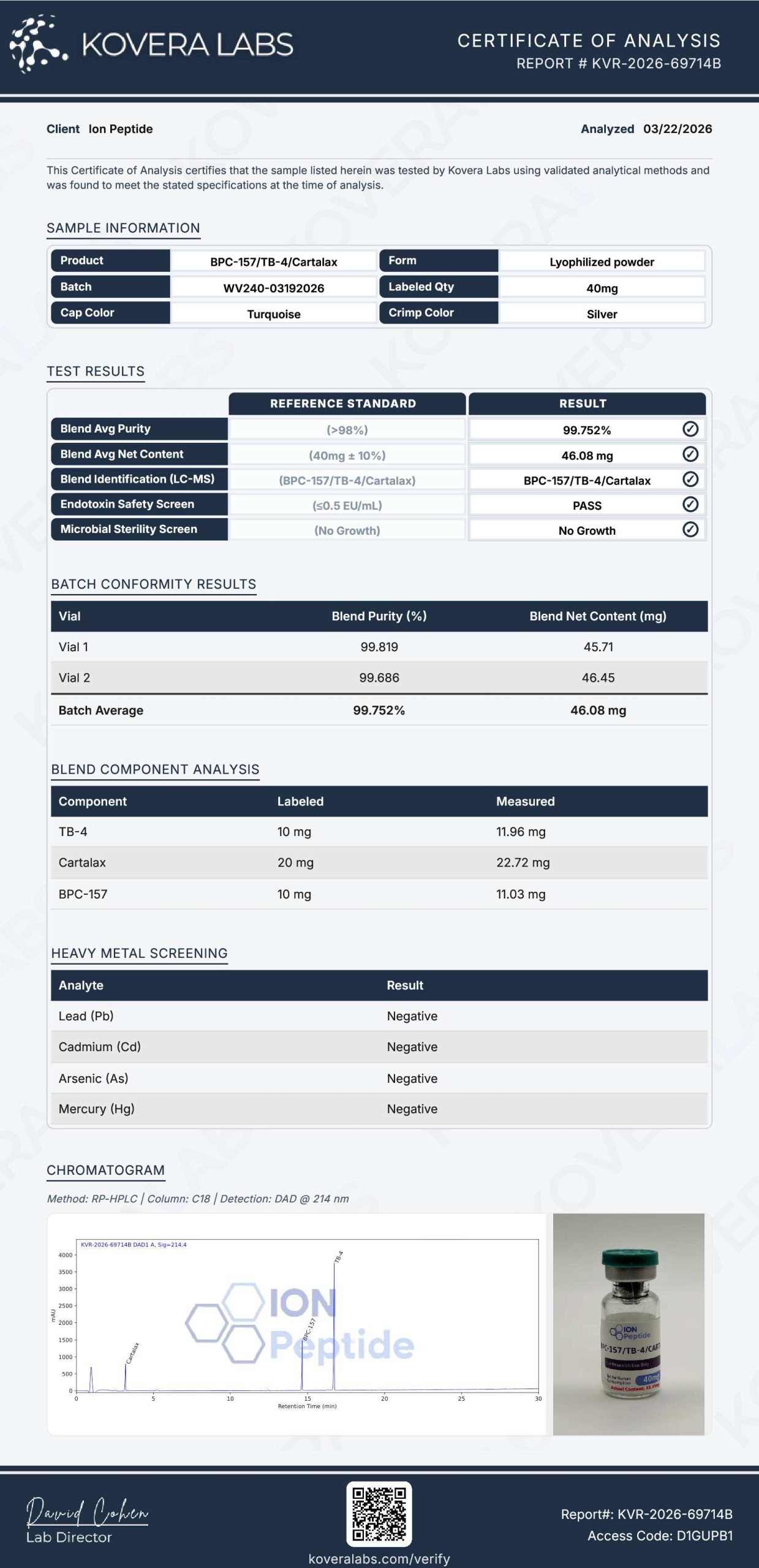
Details

Product Name Cartalax / TB4 / BPC-157
Compound Class Multi-peptide research formulation
Components Cartalax, Thymosin Beta-4, BPC-157
Form Lyophilized powder

Research

Research Applications

Combinational Peptide Interaction Studies

This formulation enables investigation of multi-peptide systems within controlled laboratory environments, allowing researchers to evaluate interaction dynamics between structurally distinct peptide classes.

Cytoskeletal & Structural Protein Research

The TB4 component is studied for its role in actin-binding and cytoskeletal regulation, supporting experimental models focused on intracellular structural dynamics.

Tissue-Associated Gene Regulation Models

Cartalax represents a tissue-associated peptide class used in studies examining transcriptional regulation and cellular homeostasis in controlled research systems.

Peptide Signaling & Intracellular Pathway Research

BPC-157 is used in experimental models evaluating cellular communication pathways and structure–activity relationships of short peptides.


References
  1. Goldstein AL, Kleinman HK. Thymosin beta-4: Actin-binding and biological properties. Annals of the NY Academy of Sciences.
    https://nyaspubs.onlinelibrary.wiley.com/doi/10.1111/j.1749-6632.2010.05728.x

  2. Khavinson VKh, et al. Peptide regulation of gene expression and protein synthesis. Biogerontology.
    https://link.springer.com/article/10.1007/s10522-011-9363-8

  3. Sikiric P, et al. Biological activity of BPC-157 in experimental models. Current Pharmaceutical Design.
    https://pubmed.ncbi.nlm.nih.gov/19754388/

  4. Peptide structure and classification overview.
    https://en.wikipedia.org/wiki/Peptide

Mechanism of Action

Mechanism of Action
Epigenetic & Gene Regulation Modeling (Cartalax)

Studied in research systems exploring short peptide influence on transcriptional activity and protein synthesis balance.

Actin Binding & Cytoskeletal Modulation (TB4)

TB4 is known to bind G-actin in laboratory models, influencing cytoskeletal organization and cellular structure research.

Peptide Signaling Pathway Interaction (BPC-157)

Investigated for interaction with intracellular signaling cascades and nitric oxide–related pathways in experimental systems.

Multi-Component System Evaluation

When combined, these peptides allow controlled research into multi-pathway peptide behavior, without implying synergistic or therapeutic claims.


References
  1. Goldstein AL, Kleinman HK. Thymosin beta-4: Actin-binding and biological properties. Annals of the NY Academy of Sciences.
    https://nyaspubs.onlinelibrary.wiley.com/doi/10.1111/j.1749-6632.2010.05728.x

  2. Khavinson VKh, et al. Peptide regulation of gene expression and protein synthesis. Biogerontology.
    https://link.springer.com/article/10.1007/s10522-011-9363-8

  3. Sikiric P, et al. Biological activity of BPC-157 in experimental models. Current Pharmaceutical Design.
    https://pubmed.ncbi.nlm.nih.gov/19754388/

  4. Peptide structure and classification overview.
    https://en.wikipedia.org/wiki/Peptide

Certificate of Authenticity