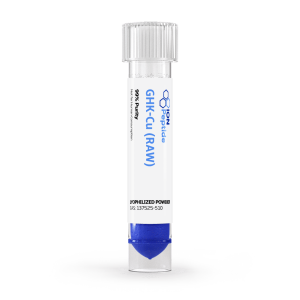

Cartalax – 20mg

$79.00

For research purposes only. Not for human or animal use & not FDA-approved. By purchasing, you confirm you are 21 or older and qualified researcher.

In stock

Quantity Price
4 - 5 $71.10
6 - 9 $66.36
10 + $59.25
Money Back Guarantee Guaranteed Quality Customer Support Fast Shipping

Description

Cartalax

Research-Grade Peptide Bioregulator (Cartilage Tissue)
Tagline: Cartilage Gene Regulation Research


Product Description

Cartalax is a short synthetic peptide bioregulator derived from naturally occurring regulatory peptides associated with cartilage tissue. It belongs to the class of tissue-specific peptide bioregulators (cytomedins) that are studied for their ability to modulate gene expression, protein synthesis, and cellular homeostasis in a tissue-selective manner.

In laboratory research, Cartalax is used as a model peptide to study chondrocyte gene regulation, extracellular matrix metabolism, cartilage aging processes, and tissue-specific regulatory signaling. Like other short bioregulator peptides, Cartalax is investigated for epigenetic and nuclear-level interactions rather than receptor-based pharmacology.

For Laboratory and Scientific Research Use Only. Not for Human Consumption.


Why Researchers Choose Cartalax
  • Cartilage-specific peptide bioregulator model

  • Used in chondrocyte gene-expression studies

  • Supports cartilage aging & cellular homeostasis research

  • Short peptide structure (high nuclear compatibility)

  • Part of a well-documented peptide bioregulator class

  • Suitable for comparative connective tissue studies


Important Note

For laboratory and scientific research only. Not for human consumption, diagnostic, or therapeutic use.
Details

Compound Name Cartalax
Peptide Class Tissue-specific peptide bioregulator (cartilage)
Peptide Length Short peptide (2–4 amino acids)
Target Tissue (Research) Cartilage / connective tissue
Intended Research Use Cartilage gene regulation, chondrocyte aging, cellular homeostasis

Research

Research Applications

Cartilage Gene Expression Regulation

Short tissue-specific peptides have been shown to influence transcriptional activity in target tissues. Cartalax is used in research models examining gene expression patterns specific to chondrocytes.

Cartilage Aging & Extracellular Matrix Homeostasis

Peptide bioregulators are studied for their involvement in age-related changes in cartilage tissue, including protein synthesis balance and extracellular matrix maintenance.

Epigenetic & Nuclear Signaling Research

Due to their small size, short peptides may interact with DNA and histone structures, making Cartalax relevant for epigenetic regulation studies in cartilage and connective tissues.


References
  1. Peptide Bioregulators: Types, Uses & Mechanisms
    Explains the biology and regulatory concepts behind peptide bioregulators — short, tissue-targeted peptides that interact with gene expression and protein synthesis.
    https://allaboutpeptides.com/peptide-bioregulators/

  2. What Are Khavinson Peptides? Intro to Peptide Bioregulators
    Describes the history, mechanism, and tissue specificity of Khavinson bioregulator peptides (short amino acid sequences interacting with DNA). Useful for class-based mechanism.
    https://edgepeptides.com/what-are-khavinson-peptides-bioregulators/

  3. Cartalax Research Overview — Bioregulatory Peptide & Tissue Role
    Discusses Cartalax as a synthetic peptide investigated for its effects on cartilage homeostasis, gene expression, and connective tissue biology in research settings.
    https://tydes.is/cartalax-peptide-research-regeneration/

  4. Cartalax Peptide: Cartilage Gene Regulation & Extracellular Matrix
    Highlights how Cartalax binds to DNA in chondrocytes to influence cartilage matrix gene expression (collagen, proteoglycans).
    https://www.seekpeptides.com/blog/articles/cartalax-peptide

  5. Peptide-Based Biomaterials for Bone & Cartilage Regeneration
    A peer-reviewed MDPI article on peptide-based strategies for cartilage tissue engineering — useful supporting context for peptide-based cartilage research.
    https://www.mdpi.com/2227-9059/12/2/313

  6. Vladimir Khavinson — Peptide Bioregulator Research Overview
    Wikipedia entry summarizing Khavinson’s decades of work developing tissue-specific peptide bioregulators and their experimental use in aging and tissue regulation.
    https://en.wikipedia.org/wiki/Vladimir_Khavinson

Mechanism of Action

Mechanism of Action
  • Epigenetic gene modulation: Interaction with chromatin and DNA

  • Tissue-specific signaling: Preferential activity in cartilage cells

  • Protein synthesis regulation: Influences extracellular matrix protein turnover

  • Cellular homeostasis support: Maintains balance in chondrocyte metabolism

  • Age-related transcription control: Studied in cartilage aging models


References
  1. Peptide Bioregulators: Types, Uses & Mechanisms
    Explains the biology and regulatory concepts behind peptide bioregulators — short, tissue-targeted peptides that interact with gene expression and protein synthesis.
    https://allaboutpeptides.com/peptide-bioregulators/

  2. What Are Khavinson Peptides? Intro to Peptide Bioregulators
    Describes the history, mechanism, and tissue specificity of Khavinson bioregulator peptides (short amino acid sequences interacting with DNA). Useful for class-based mechanism.
    https://edgepeptides.com/what-are-khavinson-peptides-bioregulators/

  3. Cartalax Research Overview — Bioregulatory Peptide & Tissue Role
    Discusses Cartalax as a synthetic peptide investigated for its effects on cartilage homeostasis, gene expression, and connective tissue biology in research settings.
    https://tydes.is/cartalax-peptide-research-regeneration/

  4. Cartalax Peptide: Cartilage Gene Regulation & Extracellular Matrix
    Highlights how Cartalax binds to DNA in chondrocytes to influence cartilage matrix gene expression (collagen, proteoglycans).
    https://www.seekpeptides.com/blog/articles/cartalax-peptide

  5. Peptide-Based Biomaterials for Bone & Cartilage Regeneration
    A peer-reviewed MDPI article on peptide-based strategies for cartilage tissue engineering — useful supporting context for peptide-based cartilage research.
    https://www.mdpi.com/2227-9059/12/2/313

  6. Vladimir Khavinson — Peptide Bioregulator Research Overview
    Wikipedia entry summarizing Khavinson’s decades of work developing tissue-specific peptide bioregulators and their experimental use in aging and tissue regulation.
    https://en.wikipedia.org/wiki/Vladimir_Khavinson

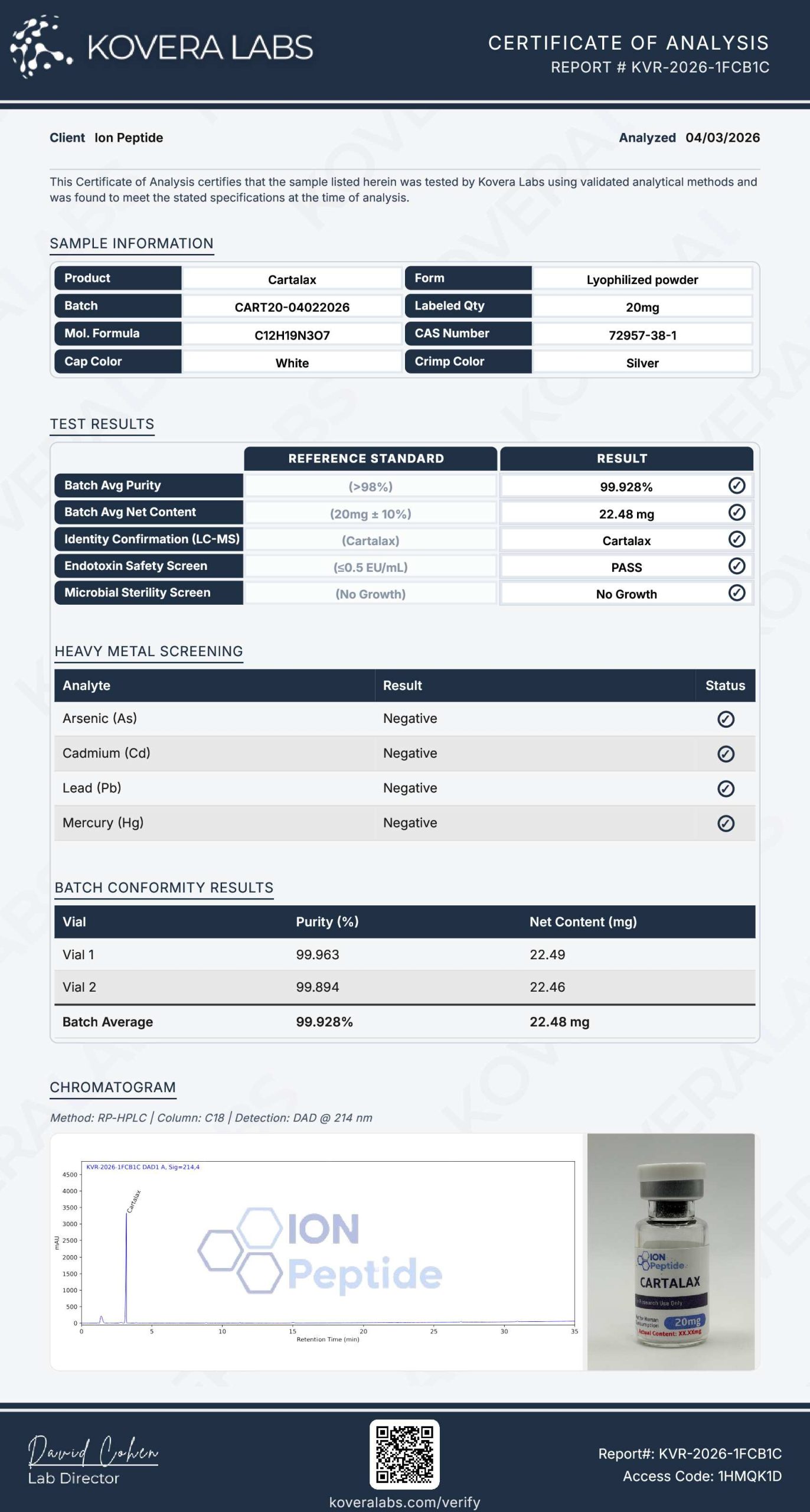
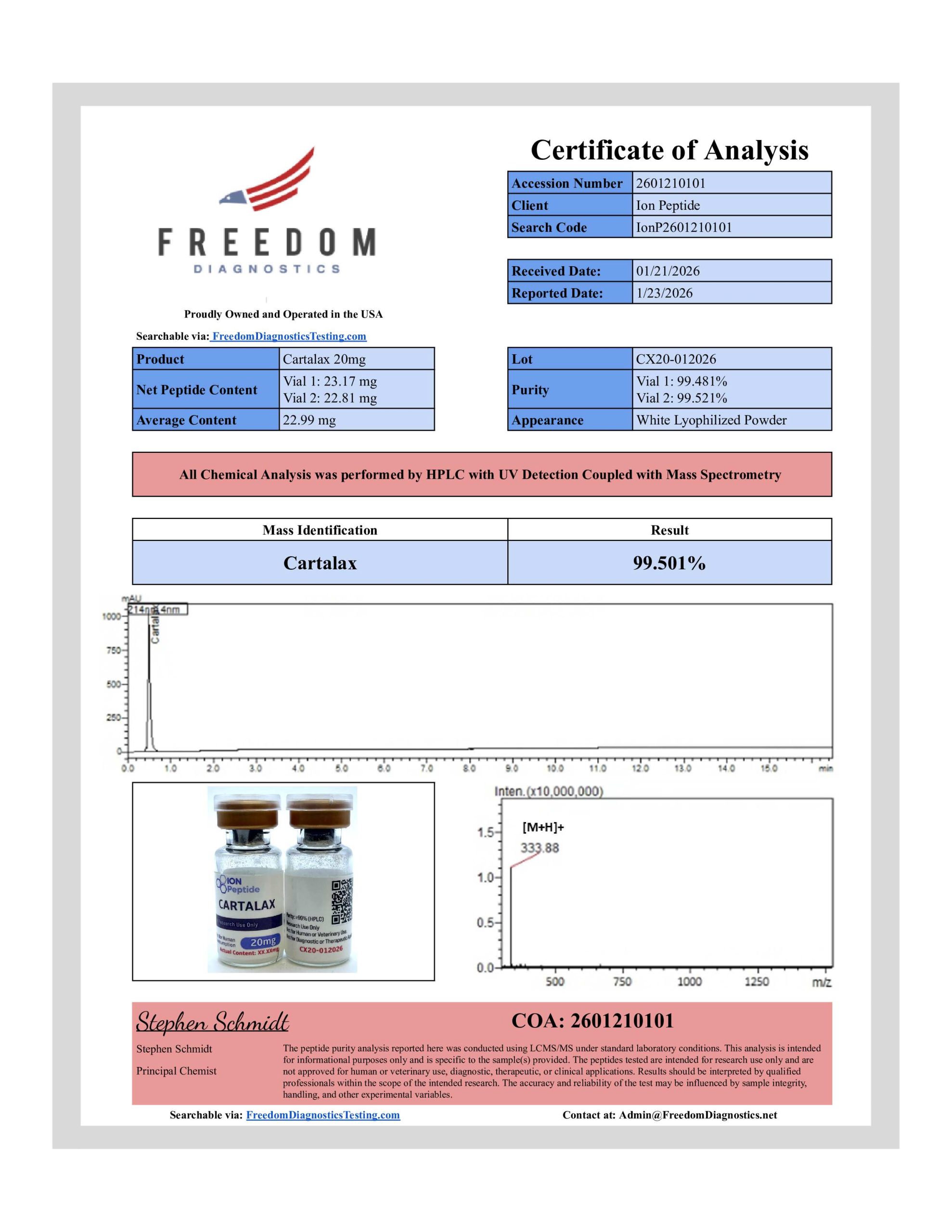
Certificate of Authenticity