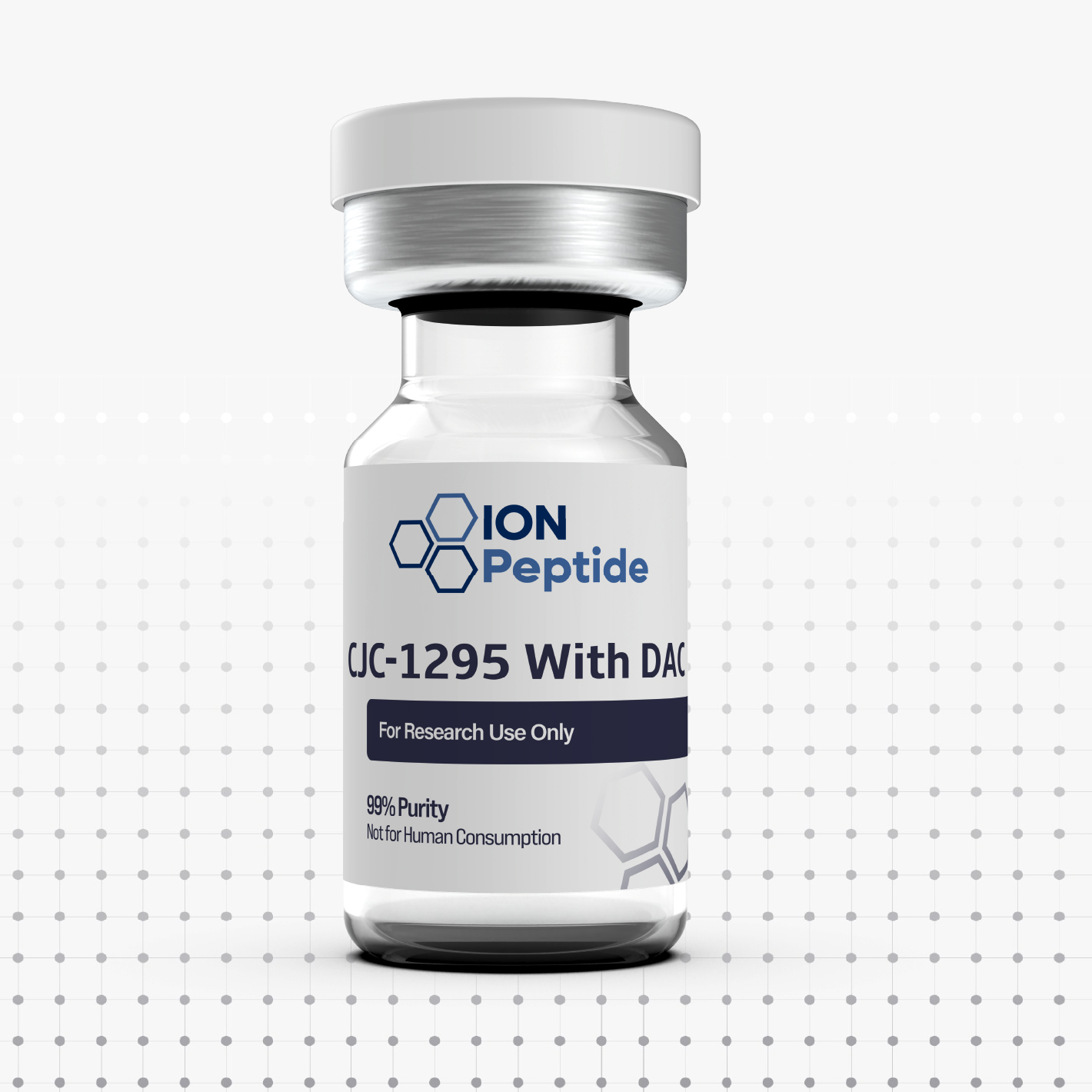
CJC-1295 With Dac – 5mg

$59.00

All products are for laboratory research purposes only. Not for human consumption, medical, or veterinary use. ION Peptides does not condone or support the use of peptides outside of controlled scientific research. By purchasing, you acknowledge that you are a qualified researcher or institution. You must be 21 or older.

In stock

Quantity Price
4 - 5 $53.10
6 - 9 $49.56
10 + $44.25
Money Back Guarantee Guaranteed Quality Customer Support Fast Shipping

Description

CJC-1295 with DAC

Research-Grade Synthetic Peptide Analog
Tagline: Peptide Signaling & Extended Stability Research


Product Description

CJC-1295 with DAC is a synthetic peptide analog derived from growth hormone–releasing hormone (GHRH) sequences, modified with a Drug Affinity Complex (DAC) to extend peptide stability in experimental systems.

In laboratory research, CJC-1295 is used as a model peptide for studying peptide–receptor interactions, signaling pathways, and peptide stability dynamics. The DAC modification enables investigation into protein-binding interactions and prolonged peptide presence in controlled environments.

This compound is utilized strictly in in vitro and biochemical research settings focusing on structure–function relationships and peptide modification strategies.

For Laboratory and Scientific Research Use Only. Not for Human Consumption.


Why Researchers Choose CJC-1295 with DAC
  • Synthetic peptide with defined sequence and modification
  • Includes DAC modification for extended stability studies
  • Suitable for peptide–receptor interaction research
  • Used in signaling pathway and protein-binding models
  • Applicable in structure–activity relationship (SAR) studies
  • Documented in peptide and biochemical research literature

Important Note

For laboratory and scientific research only. Not for human consumption, diagnostic, or therapeutic use.
Details

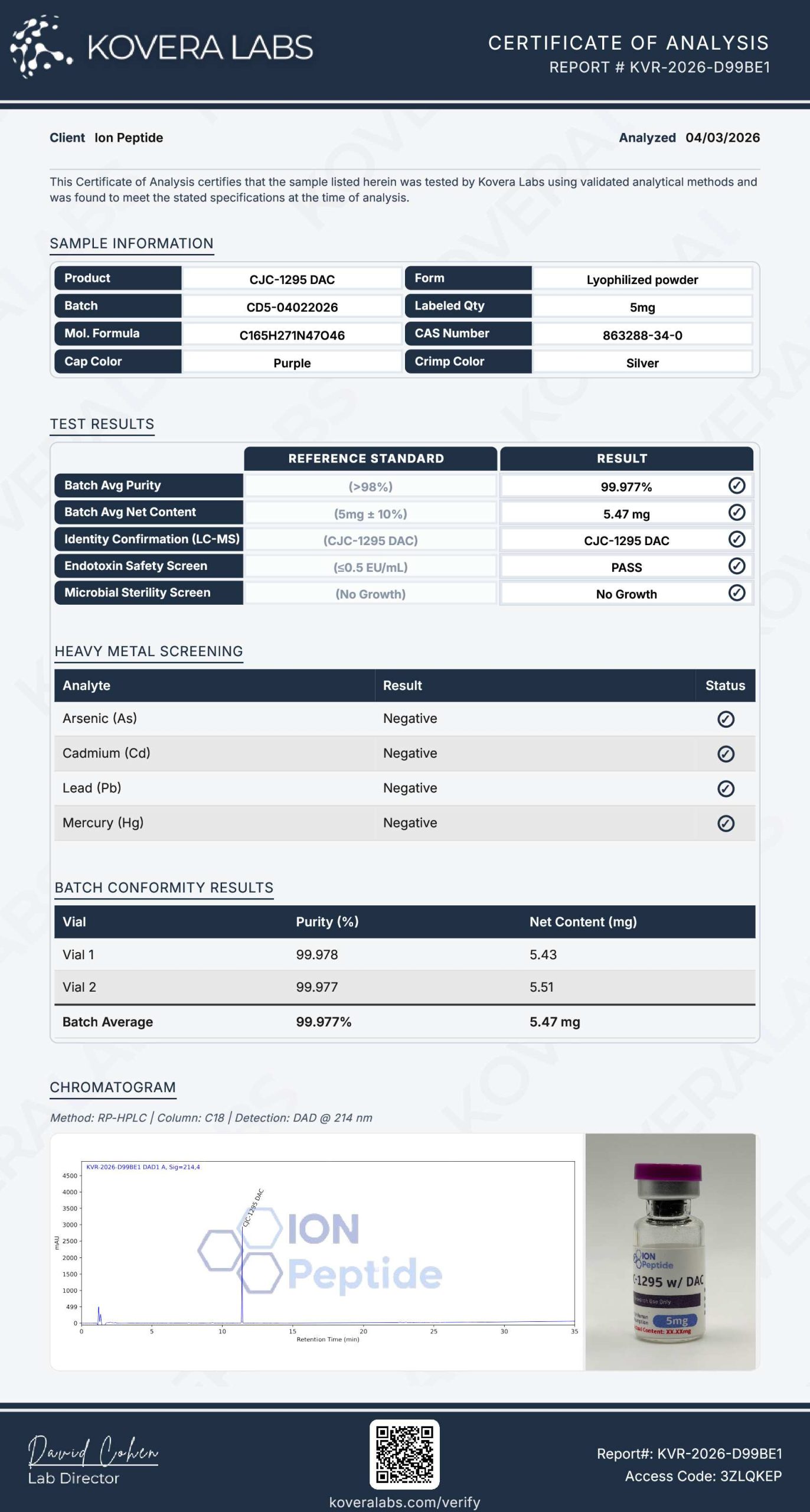
Compound Name CJC-1295 with DAC
Compound Class Synthetic peptide analog (GHRH-derived)
Modification Drug Affinity Complex (DAC)
Peptide Type Modified peptide analog
Target Context (Research) Peptide signaling, receptor interaction, stability studies
Form Lyophilized powder

Research

Research Applications

Peptide–Receptor Interaction Studies

CJC-1295 is used in laboratory models to investigate ligand–receptor binding behavior and downstream signaling pathways in controlled experimental systems.

Peptide Stability & Modification Research

The DAC modification allows study of peptide stability, binding to carrier proteins, and extended presence in experimental environments.

Structure–Activity Relationship (SAR) Analysis

Researchers use CJC-1295 to evaluate how sequence modifications influence peptide behavior, binding affinity, and signaling characteristics.

Protein Binding & Interaction Models

The modified peptide is studied for its ability to interact with circulating proteins, enabling research into peptide–protein binding dynamics.


References
  1. CJC-1295 — peptide overview and research context.
    https://pubchem.ncbi.nlm.nih.gov/compound/CJC-1295
  2. GHRH analogs and peptide signaling mechanisms.
    https://www.ncbi.nlm.nih.gov/pmc/articles/PMC3183920/
  3. Peptide modification and stability enhancement strategies.
    https://www.ncbi.nlm.nih.gov/pmc/articles/PMC5571414/
  4. Peptide structure and classification overview.
    https://en.wikipedia.org/wiki/Peptide

Mechanism of Action

Mechanism of Action
GHRH-Derived Peptide Signaling

CJC-1295 is derived from GHRH sequences and is studied as a ligand in receptor-mediated signaling models under laboratory conditions.

DAC-Mediated Protein Binding

The Drug Affinity Complex enables covalent or high-affinity binding to circulating proteins, allowing investigation into extended peptide stability.

Prolonged Presence in Experimental Systems

Due to DAC modification, the peptide is studied for extended residence time and sustained signaling behavior in research environments.

Sequence-Dependent Activity

The biological behavior of CJC-1295 is dependent on its modified amino acid sequence, making it suitable for structure–function research.


References
  1. CJC-1295 — peptide overview and research context.
    https://pubchem.ncbi.nlm.nih.gov/compound/CJC-1295
  2. GHRH analogs and peptide signaling mechanisms.
    https://www.ncbi.nlm.nih.gov/pmc/articles/PMC3183920/
  3. Peptide modification and stability enhancement strategies.
    https://www.ncbi.nlm.nih.gov/pmc/articles/PMC5571414/
  4. Peptide structure and classification overview.
    https://en.wikipedia.org/wiki/Peptide

Certificate of Authenticity